Emperor Yang of Sui Travels South of the Yangzi
隋炀帝下江南
© Tutuhaoyi.com owns the copyright of the description content for the images attached. Quoting all or part of the description content on this page is permitted ONLY IF ‘Tutuhaoyi.com’ is clearly acknowledged anywhere your quote is produced unless stated otherwise. (本页描述内容版权归Tutuhaoyi.com所有,转发或引用需注明 “Tutuhaoyi.com”, 侵权必究, 已注开源信息的条目除外。)
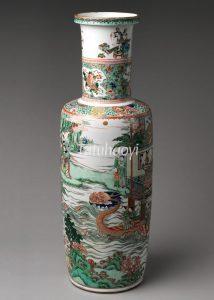
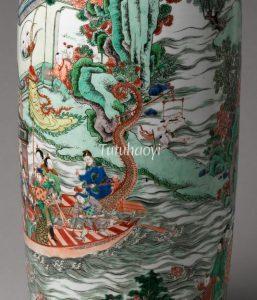
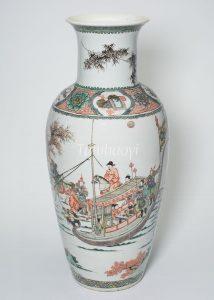
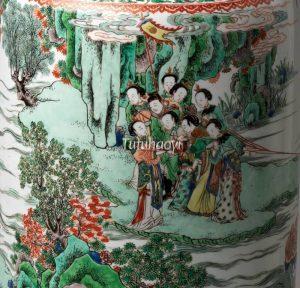
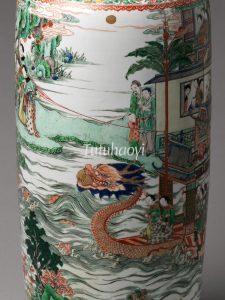
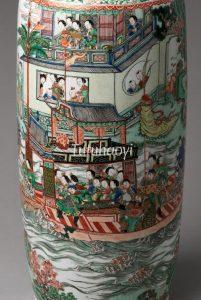
This grand figural scene is sometimes mistaken for a Dragon Boat Festival celebration. In fact, it depicts an episode from Emperor Yang of Sui’s southern excursion to Jiangdu, as described in Chapter One of Romance of the Two Dynasties of Sui and Tang 隋唐两朝志传 by Luo Guanzhong (罗贯中, c.1330–c.1400).
The passage provides the background to this imperial journey. While still Prince of Jin, Yang Guang secured the succession through intrigue and violence, eventually usurping the throne. After his accession, he indulged in extreme luxury, commissioning vast palace complexes such as the Xianren Palace and the Western Park in Luoyang, which were filled with rare treasures and elaborate spectacles. Court life became dominated by music, dance, and continual revelry, a lifestyle exemplified by his extravagant nocturnal entertainments in the Western Park, further illustrated in the entry on ‘Night Revel of the Emperor Yang of the Sui Dynasty’.
Encouraged by Empress Xiao, who praised the splendour of Jiangdu, the emperor resolved to travel south in pursuit of ever greater pleasures. Ignoring loyal remonstrance and heeding only flattering counsel, he set out on a grand imperial progress, intent on exhausting the delights of the realm. Upon reaching Jiangdu, his indulgence deepened still further, as reflected in the related scene of ‘Emperor Yang of Sui Appreciating Lotus at Jiangdu’.
During this journey, the emperor travelled aboard an immense dragon boat constructed in the form of an imperial palace, complete with halls, terraces, and quarters filled with court ladies, musicians, and performers. Hundreds of accompanying vessels stretched for miles along the waterways, while tens of thousands of conscripted labourers hauled the boats from the banks. Torches illuminated the route through the night as if it were day, and cavalry units rode in formation along both shores under a forest of banners. Along the way, local officials were compelled to supply provisions for the vast retinue. The resulting spectacle—palace women towing the boats, guards riding alongside on land, and the emperor feasting amid music and dance—captures both the grandeur and the excess of his reign, and serves as a lasting moral critique.
story scene description by Rachel Ma
Related Figures & Stories:
Bo Yi and Shu Qi Trying to Stop the Mighty Zhou Army 伯夷、叔齐叩马谏周王
Duke Ling of Jin Sending His Dog to Attack Zhao Dun 晋灵公嗾獒咬赵盾
Fig 1-5: famille verte porcelain vase, Kangxi period (1662–1722), Qing dynasty, courtesy of the Metropolitan Museum of Art, New York
Fig 6: famille verte porcelain vase, Kangxi period (1662–1722), Qing dynasty, courtesy of the Art Institute of Chicago